Nigeria’s financial sector has entered 2026 on firmer footing than it did a year earlier, supported by a sweeping recapitalisation programme that has injected roughly ₦5 trillion into the banking system. The capital inflow is reshaping how lenders assess risk, expand loan books, and position for growth.
Economic projections remain constructive. Growth forecasts for 2026 range between 4.0% and 5.5%, based on estimates from the Central Bank of Nigeria (CBN), the World Bank, and the International Monetary Fund. Inflation has eased from last year’s highs, consumer demand has remained resilient, and banks are increasingly repricing loans to defend interest margins.
Despite the improved outlook, challenges persist. Loan defaults are rising in select segments of the economy, while foreign exchange pressures continue to weigh on balance sheets. The naira has stabilised around ₦1,400 to the dollar, an improvement from 2024, but currency risk remains a structural concern for lenders.
Policy actions by the CBN have helped calm market volatility. Tighter monetary controls improved digital revenue collection, and stronger oversight have boosted investor confidence. External reserves have also risen to $46.18 billion, according to the CBN’s January 29, 2026 update.
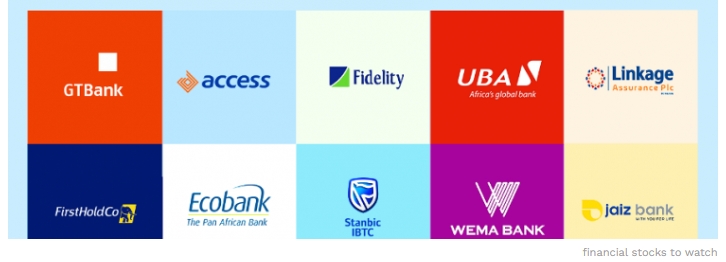
While the overall direction is positive, performance across the sector is expected to vary. Asset quality, cybersecurity exposure, and capital discipline are likely to determine which institutions outperform. Against this backdrop, analysts and investors are closely watching several financial stocks based on early trading patterns, balance sheet strength, and market commentary.
1. Guaranty Trust Holding Company Plc (GTCO)
GTCO remains one of the most actively tracked banking stocks on the Nigerian Exchange. Trading around ₦99, the stock offers an estimated dividend yield of about 8.6%, underpinned by steady earnings and a strong retail franchise.
Its continued investment in digital banking has driven growth in transaction volumes and fee income.
CardinalStone Partners recently upgraded the stock to a “Buy,” citing potential upside of up to 30% as expanded capital supports higher lending. GTCO’s operations across multiple African markets provide exposure to regional trade, though shifting policies and tariffs could influence earnings.
The group is listed on both the NGX and the London Stock Exchange.
2. Access Holdings Plc (ACCESSCORP)
Access Holdings is widely viewed as a key beneficiary of recent regulatory reforms. Analysts have pointed to improvements in capital adequacy and funding structure following recapitalisation efforts.
The stock closed at ₦22.55 on Monday, February 2, 2026. With private sector credit expected to expand, Access Bank is positioned to benefit, particularly through corporate and trade-related lending activities.
3. Fidelity Bank Plc (FIDELITYBK)
Among mid-tier lenders, Fidelity Bank has delivered one of the stronger early-year performances. Trading under the ticker FIDELITYBK, the bank continues to advance its recapitalisation strategy.
Analysts cite tighter cost controls and improving operational efficiency as key positives, with valuation models suggesting potential returns in the range of 12% to 15%.
4. United Bank for Africa Plc (UBA)
UBA closed trading at ₦43.90 on the NGX on Monday, February 2, 2026. As a tier-one lender and member of the FUGAZ group, UBA benefits from scale and a broad geographic footprint across Africa.
Its regional presence supports long-term growth prospects, although investors remain attentive to non-performing loan levels, particularly in higher-risk markets.
5. Linkage Assurance Plc (LINKASSURE)
Insurance stocks have continued to attract investor interest, and Linkage Assurance reflects this broader trend. The stock has started the year slightly lower, posting a year-to-date decline of 0.56%.
As with the wider insurance segment, performance remains closely tied to capital strength, underwriting discipline, and claims management.
Rising capital levels across the financial sector provide room for expansion but also increase exposure to credit risk. Analysts warn that non-performing loans could edge toward the 6% to 7% range if economic conditions tighten. PwC has highlighted uneven performance across institutions, advising investors to prioritise banks with strong capital buffers and disciplined risk management frameworks.
6. First HoldCo Plc (formerly FBN Holdings)
First HoldCo remains a major tier-one banking group with a significant market presence. The stock has shown renewed strength following recapitalisation milestones.
While its scale and large loan book make it a core holding for many investors, historical concerns around governance and asset quality continue to shape sentiment. In its 2025 full-year results, the group reported pre-tax profit of ₦229.10 billion, representing a 71.18% decline, while profit after tax fell by 93.36%. Credit costs and balance-sheet cleanup will be closely monitored in 2026.
7. Ecobank Transnational Incorporated (ETI)
ETI offers investors broad exposure across West and Central Africa. Several brokerages have maintained or upgraded positive outlooks, citing earnings resilience and diversification across markets.
Currency risks and uneven regional performance remain challenges, but the group’s cross-border business model continues to appeal to investors seeking non-domestic growth exposure. Moody’s Ratings upgraded Ecobank’s outlook to stable in July 2025 while affirming its B3 long-term issuer rating.
8. Stanbic IBTC Holdings Plc
Stanbic IBTC continues to trade at a premium valuation, supported by its focus on corporate and investment banking, strong balance sheet, and full compliance with capital requirements.
While growth may be steadier than that of higher-beta peers, its consistent execution and lower volatility position it as a defensive option within financial sector portfolios.
9. Wema Bank Plc
Wema Bank has sustained momentum from previous periods, driven by digital banking initiatives and successful capital strengthening. Although smaller in scale compared to tier-one competitors, its innovation-led strategy has kept the stock on investors’ watchlists.
10. Jaiz Bank Plc
Jaiz Bank, Nigeria’s leading non-interest lender, continues to attract attention as it meets recapitalisation requirements. Its ethical and Sharia-compliant banking model appeals to both retail and institutional investors seeking alternative financial products within the sector.
For deeper market insights, stock analysis, and expert commentary on Nigeria’s financial sector, visit LouisaOlaniyi.com.ng.