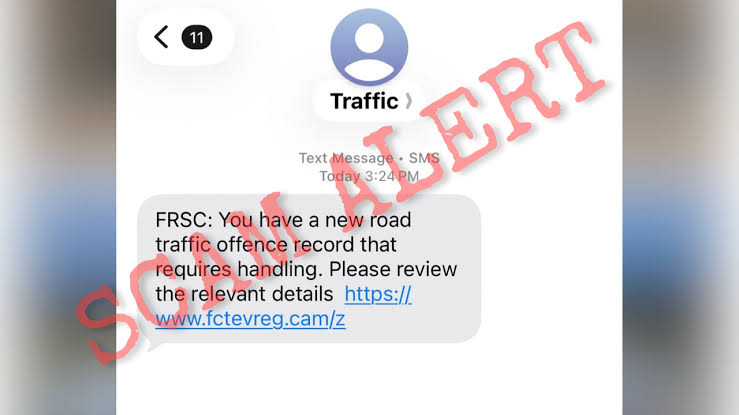

Nigerians woke up this week to a wave of unsolicited text messages claiming they had committed traffic offences under the Federal Road Safety Corps (FRSC).
The messages, often appearing under the name “Traffic” or simply labelled as FRSC alerts, warned recipients of new road traffic offence records and urged them to click a link to review the details and settle the fine.
Several people who followed the links have reported losing significantly more money than the few thousand naira they were initially asked to pay.
Comedian MC Monica, whose real name is Edeh Sylvester Chisom, shared his experience on Instagram after receiving one of the messages. He clicked the link and paid what he believed was a ₦5,000 fine.
The following morning, he discovered that roughly ₦1.8 million had been withdrawn from his Wema Bank account through unauthorised web transactions.
Screenshots he posted showed a large “WEB Buy” debit among other transfers. According to MC Monica, his account officer told him little could be done. He subsequently tagged the official FRSC account, asking how his details had reached the scammers.
Similar reports have emerged from other victims.
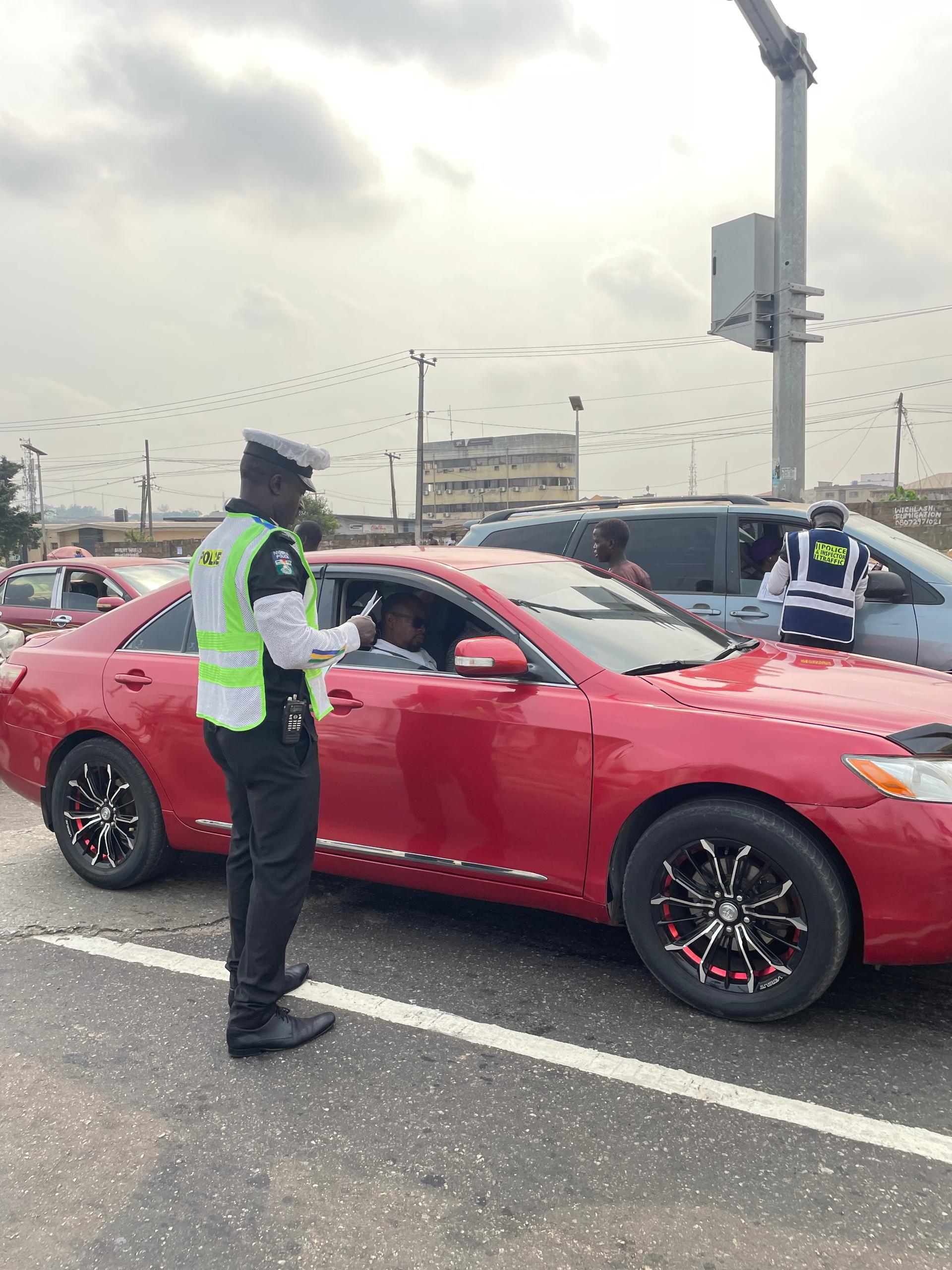
Nollywood actress Eva Ibiam reportedly lost around ₦364,000 after responding to a comparable message. She had recently been stopped by road safety officers who photographed her vehicle’s plate number, making the fraudulent alert appear credible.
Her bank records reportedly showed a genuine one-time password (OTP), followed minutes later by an international web purchase linked to a merchant in Dubai.
Actor Deza The Great also reported losing about $2,500 after entering his card details on one of the websites linked to the scam.
The Federal Road Safety Corps has since moved to distance itself from the messages, describing them as fraudulent.
In a statement issued on September 16 and signed by the Corps Public Education Officer, Osondu Ohaeri, the agency said the messages were being circulated through mobile devices and social media.
The FRSC specifically disowned websites such as frscgov.top/ng, stating that they have no affiliation with the Corps. It advised members of the public to use its official website, frsc.gov.ng, and its national toll-free number, 122, when seeking information or verifying traffic-related matters.
According to the Corps, the fraudulent messages create a sense of urgency by claiming that a new traffic offence has been recorded and directing recipients to “review the relevant details.”
The agency warned that the links appear designed to collect personal and financial information, including passwords, card details, driver’s licence numbers and vehicle registration information.
It advised members of the public not to click on the links, make payments or provide banking information in response to such messages. Anyone who receives a suspicious message was also advised to preserve the evidence and report it through the appropriate channels.
The pattern suggests a phishing operation designed to impersonate government enforcement agencies. Victims are directed to websites that mimic official portals, where they are shown an alleged traffic violation and asked to provide card details and a one-time password to settle a relatively small fine.
Once the information is entered, larger unauthorised transactions can follow, including transactions routed through overseas merchants.
Some of the domains reportedly used in the campaign have endings such as .top, .cam and .cc rather than the legitimate .gov.ng domain used by Nigerian government agencies.
Cybersecurity observers say the scam reflects a broader pattern in which fraudsters exploit the credibility of Nigerian government institutions to make phishing attempts appear legitimate. The relatively small initial payment request can also make victims less suspicious, while the primary objective is to obtain banking information that can be used for larger transactions.
Questions remain over how the operators obtained the phone numbers targeted by the campaign. Some observers have suggested that the numbers may have come from existing data circulating in illicit markets, although there is no confirmation that a particular database or breach was responsible.
The FRSC has urged motorists to verify any alleged traffic offence through its authorised channels and to share information about the scam with others.
Corps Marshal Shehu Mohammed has also called for increased public sensitisation, urging Nigerians to stop, verify and report before acting on messages claiming to come from the agency.
For motorists who receive unsolicited messages about traffic fines, the FRSC’s warning is clear: do not click suspicious links or provide banking information before independently verifying the claim.
Legitimate FRSC payments are made through commercial banks or the official Remita platform after a proper notice of offence, rather than through random links sent by SMS.