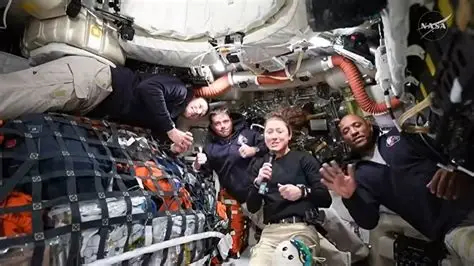
The Artemis II astronauts have safely returned to Earth, marking a major milestone for NASA after completing the first crewed lunar flyby in more than five decades. The spacecraft carrying four astronauts — three Americans and one Canadian — splashed down successfully off the California coast, concluding a high-stakes test mission that also delivered remarkable images of the Moon.
Mission commander Reid Wiseman described the experience succinctly, saying, “What a journey,” while confirming that the crew — Christina Koch, Victor Glover, and Jeremy Hansen — were “stable” and “green.” NASA public affairs official Rob Navias clarified the meaning of that status, noting, “They’re in great condition, that’s what that means.”
Tension briefly mounted during the expected communications blackout as the spacecraft re-entered Earth’s atmosphere, but relief followed once Wiseman re-established contact with mission control in Houston. “We have you loud and clear,” he said after a successful voice check, confirming the crew’s safe return trajectory.
Recovery operations were carried out swiftly, with NASA personnel and the US military assisting in retrieving the astronauts from the capsule. Applause broke out in mission control as the crew was extracted and later airlifted by helicopter to a recovery ship near San Diego, where all four astronauts were able to walk without assistance.
NASA administrator Jared Isaacman hailed the mission as “a perfect mission,” adding, “We’re back in the business of sending astronauts to the moon,” and “this is just the beginning.”
Artemis II Re-Entry Pushes Spacecraft to Limits
The return journey itself tested the spacecraft under extreme conditions. Travelling at speeds exceeding 30 times the speed of sound, the capsule endured intense heat — reaching temperatures roughly half as hot as the surface of the Sun. This phase was crucial in evaluating the performance of the Orion heat shield, especially after complications encountered during an earlier uncrewed test flight.
Flight director Rick Henfling acknowledged the tension surrounding re-entry, stating, “If you didn’t have anxiety bringing this spacecraft home, you probably didn’t have a pulse.” Despite the concerns, the re-entry proceeded without incident, and the Orion capsule will now undergo detailed inspection to assess its performance.
US President Donald Trump praised the mission, calling the journey “spectacular” and expressing pride in the astronauts. Looking ahead, he wrote on social media: “Next step, Mars!”
The mission, which lasted nine days, one hour, 31 minutes and 35 seconds — though rounded up by NASA to 10 days — began with a dramatic launch from Florida on April 1. During the voyage, the crew reached a record-breaking distance of 252,756 miles (406,771 kilometres) from Earth, making them the farthest-travelling humans in history.
While orbiting the Moon and travelling through deep space, the astronauts captured thousands of images, witnessed a solar eclipse, and observed meteorite impacts on the lunar surface. The mission also marked several historic firsts: Glover became the first person of colour to fly around the Moon, Koch the first woman, and Hansen the first non-American to take part in such a mission.
Astronomer Derek Buzasi described the mission as “an almost flawless success,” adding, “I admit to having had my doubts about the Artemis program, but now I have fresh confidence in our next steps as we go back to the moon to stay.”
Artemis II represents the first crewed mission in NASA’s broader Artemis programme, which aims to establish a sustained human presence on the Moon and lay the groundwork for future missions to Mars. The agency is targeting a potential lunar landing by 2028, though experts have expressed concerns about whether key technologies, including landers being developed by SpaceX and Blue Origin, will be ready in time.
Meanwhile, China is advancing its own lunar ambitions, aiming to send astronauts to the Moon by 2030. As global competition in space intensifies, analysts say Artemis II serves as a powerful demonstration of capability and intent.
According to Clayton Swope of the Centre for Strategic and International Studies, the mission stands as “proof that when America keeps its eye on the prize, it can still do very great things.”
AFP
Stay informed with the latest global developments, from space exploration breakthroughs like Artemis II to stories shaping our world today. Visit LouisaOlaniyi.com.ng for more timely updates, in-depth reports, and exclusive insights.